About Goy (EN)
DeEgo | Embodiment Pratice
A gentle space for those who may never have felt safe enough to fully be themselves. Here, we gradually learn to listen to our bodies, understand our inner experiences, and reconnect with our ability to make choices in our own lives.
Goy | Trauma-Informed Yoga Facilitator
Yoga that understands the nervous system, the body, and the impact of trauma.
My work draws on Trauma-Informed Yoga, Somatics, and Embodiment Practices, with an emphasis on creating a space that respects each person’s feelings, pace, and choices. I believe that healing should never become another thing we have to force ourselves to accomplish.

The Beginning: My Body and Chronic Health Challenges
I never imagined that one day I would become interested in Trauma-Informed Yoga. There was a time when I barely knew what trauma was, let alone that I might have experienced it myself.
I had always been the kind of person who fit society’s expectations: a good student, a high achiever, strong, responsible, and someone who could handle everything. I achieved what others considered to be “good enough.” But my body was telling a different story.
Over time, I began experiencing a range of chronic health challenges that were difficult to explain, including:
- Frequent headaches and migraines
- Chronic neck, shoulder, and upper back pain
- Shallow breathing and unconsciously holding my breath
- Eye strain, dizziness, brain fog, and difficulty concentrating
- Constipation, acid reflux, and digestive issues
- Persistent exhaustion, even after resting
- Difficulty sleeping and waking up during the night
- Anxiety and panic attacks
- A sense of emptiness inside
These were ways my body was communicating with me — signals from within. But at the time, I genuinely didn’t understand what was happening. I only knew that something was happening, but I didn’t know how to listen to my body or make sense of what it was trying to tell me.
The Journey: From Living Through the Mind to Reconnecting with the Body
For most of my life, I relied heavily on my mind to navigate the world. I would think, analyze, search for explanations, try to understand everything, and find ways to manage things on my own.
Looking back, I have begun to understand that relying so heavily on my mind may not have been simply a personality trait. It may also have been one of the ways I learned to protect myself — something familiar that gave me a sense of control and the ability to manage what was happening around me. When we have relied on this way of coping for so long, coming back to the body may not be as easy as it sounds.
I also used to believe that trauma had to come from major or life-threatening events. Since I didn’t think I had experienced anything like that, I never questioned whether trauma might be part of my own story.
As I learned more, I began to understand that trauma is not determined by the event alone. It is also connected to how the nervous system and body respond to and cope with an experience. As I gradually began paying attention to my inner experiences, I started noticing connections between what had happened in my life, the way I had learned to live, and what my body was expressing.
I began noticing things that had been part of my everyday life, but that I had never really questioned, such as:
- Constant overthinking and rumination
- Smiling to hide fear
- Trying to appear strong while concealing insecurity
- Using logic and analysis to make sense of everything
- Living with persistent physical tension
- Feeling guilty whenever I rested
- Constantly pushing myself to do more
- Living in survival mode rather than truly living
This led me to become increasingly interested in the relationship between the mind, body, and nervous system. I began exploring Trauma-Informed Yoga, Somatics, Embodiment, and the practice of listening to the body.
Understanding: Reconnecting with the Body Is Not as Simple as It Sounds
There is something I especially want people to understand: reconnecting with the body is not simply about stopping our thoughts and starting to feel.
Imagine someone who has relied on thinking as their primary way of coping with life. When someone tells them to stop thinking, close their eyes, take a deep breath, or focus on the sensations in their body, what happens next may not be calmness. It may bring up fear, discomfort, unfamiliarity, or a sense of unsafety.
For some people, being with their inner sensations may be something they have never learned how to do. They may have had very few experiences of feeling grounded, secure, and safe in their own bodies (a baseline experience of safety) — so they may not even know what that feels like in the first place.
When it doesn’t come easily, we may start blaming ourselves: Why can everyone else do it? Why can’t I? Why is simply breathing or noticing my body so difficult? And the harder we try to force ourselves to feel, relax, or get it right, the more resistance we may experience. We might hold our breath, feel stuck, or begin to believe that something is wrong with us.
I understand this feeling because I was once someone who didn’t know how to begin reconnecting with my own body. And if there is one thing I want to tell you, it is this:
You don’t need to feel guilty or blame yourself all over again simply because you haven’t been able to do what is called healing. Healing is not something we have to accomplish. It is a process of gradually learning to come back to ourselves, at a pace that feels right for us.
We all have different life experiences. There is no single healing approach that works for everyone. Each of us has our own path and our own pace.
A Turning Point: Trauma-Informed Yoga and the Power of Choice
What drew me more deeply to Trauma-Informed Yoga was the concept of Choice.
To me, Trauma-Informed Yoga is not about taking us back into painful memories or forcing us to confront every feeling. It is about creating a space where we are respected, not judged, and never required to push ourselves beyond what feels right.
We may choose to move or remain still, to close our eyes or keep them open, to notice sensations in our bodies or turn our attention toward something else that helps us feel more grounded. We don’t have to follow every instruction. We don’t have to feel the same way as someone else. And we don’t have to rush toward a destination defined by others. Sometimes, what matters most is not making ourselves feel calm immediately, but beginning to have choices in our own experience.
Healing does not happen simply because we intellectually understand what has happened to us. It also takes time and repeated new experiences for the body and nervous system to learn.
Some days, we may still shake, feel afraid, experience intense emotions, or feel caught in familiar patterns. This doesn’t mean we have failed or made no progress. Progress in healing doesn’t necessarily mean never feeling afraid, never being shaken, or never being triggered by something from the past again. It may mean gradually having more choices in how we respond to what is happening, while creating new experiences for ourselves, even when familiar feelings are still present.
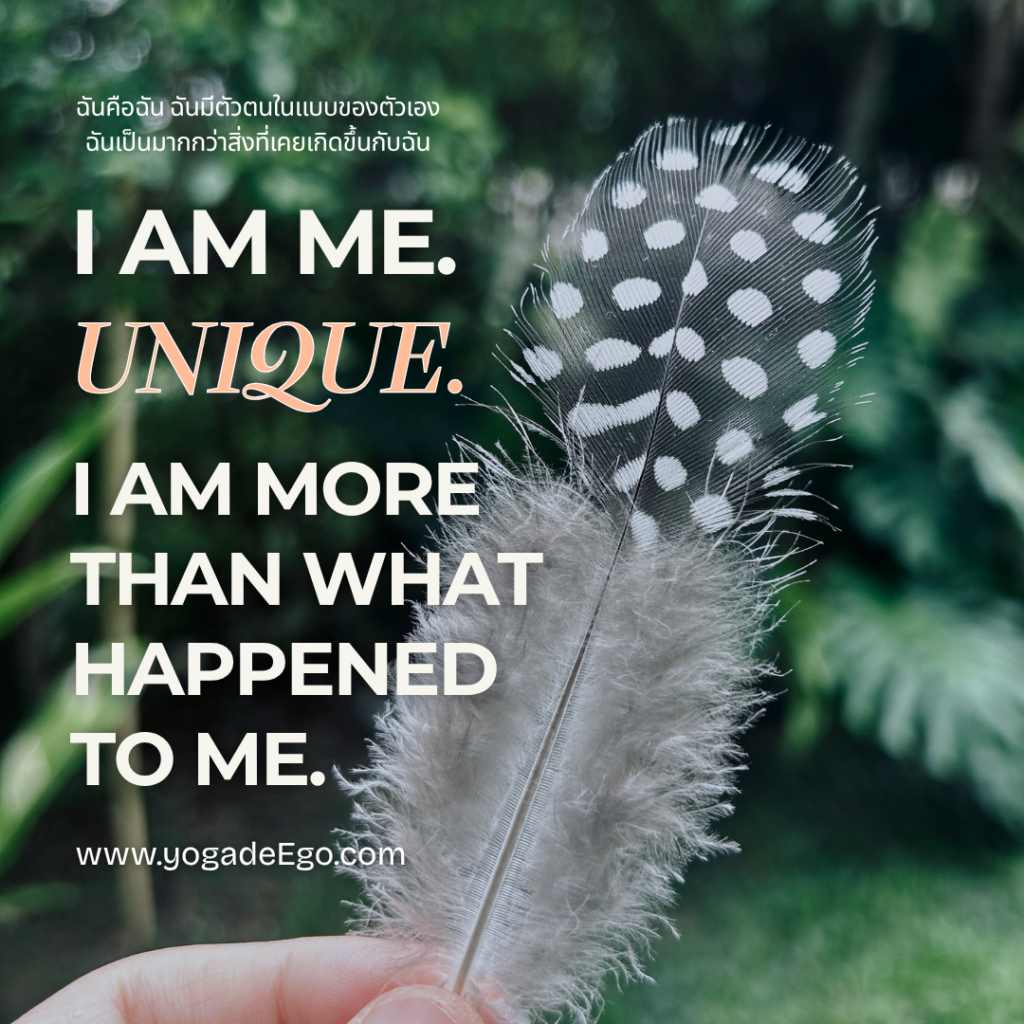
I am more than what happened to me.
My work and ongoing learning focus on body awareness and nervous system support, including:
• Trauma-Informed Yoga (currently studying)
• Yin Yoga
• Nervous System Support
• Gentle Breathwork (with an emphasis on choice rather than forcing the breath)
• Somatic Awareness
• Embodiment Practice
• Radical Acceptance
DeEgo: A Space Where You Don’t Need to Prove Anything
I created DeEgo Embodiment Yoga with the intention of offering a particular kind of space.
A space for those who have spent so long living in their minds. Those who have always tried to understand everything on their own. Those who are used to being strong, yet find it difficult to trust their own feelings or listen to what their bodies are telling them.
I want this to be a space where you don’t have to force calmness, compel yourself to feel safe, or prove how well you are healing. You have the right to feel. You have the right not to be ready. You have the right to pause. And you have the right to choose what feels right for you.
I don’t have all the answers, and I don’t believe there is one approach that works for everyone. If reconnecting with your body feels difficult, I want you to know that I understand how hard it can be. Letting go of the ways we have relied on to protect ourselves for so long is not a small thing. And we don’t have to rush.
We don’t have to reject our past. We don’t have to rush ourselves into healing. And we don’t have to spend our entire lives proving how strong we are. We are more than what happened to us. And our past does not have to define the rest of our lives.
DeEgo is not here to take you back to the person you were before you were wounded. It is about offering a space where you can continue discovering who you are, with more choices, a deeper awareness of your body, and the freedom to move forward on your own path.
Because we were not born simply to survive. We deserve to live a life that truly belongs to us.
— DeEgo Embodiment Yoga
Stay Connected
Follow my journey, learning, and activities related to Trauma-Informed Yoga:
Instagram: @yogadeeo
Facebook: DeEgo Embodiment Yoga : ดีอีโก้ โยคะฟังร่างกาย
Website: www.yogadeEgo.com